
Decorative Flower
Her Realm
Mar 28

Selling Yourself Is Not the Same as Selling Out

My heart is broken. I’ve lost a good friend, and arguing over blogging isn’t on top of my list of things I’d like to do. However, I’m doing it anyway. Any I’m not even sure why. I’m not even sure what the argument is anymore, but here’s the back story.

A blogger asked a group of bloggers about where to draw the line between pleasing brands and readers. She viewed her readers as ultimately the most important. I agreed, and replied about how my main goal with Reviews by Cole is to be honest and to provide a real service to my readers. In fact, my most commented on posts are reviews of items that I bought myself and gave honest, and usually negative, reviews on. Consumers search out those reviews, and they feel so strongly about the same subject that they are compelled to leave comments. It’s kind of amazing because some of the things I’ve written and have expected to be less popular are the most popular posts on my site.

And, yes, I write for my readers because my review blog is a hobby. Oh, it’s a labor of love, all right, and I bet some people wonder why I do it considering that I don’t get paid for it, and I can understand that. Then again, plenty of people put time and money and labor into hobbies like that. However, I started blogging so many years ago, and monetization wasn’t a word. I mean, we were just trying to figure out HTML and how to add comments. No one was how PR and social media would be in 2013.

It’s been almost five years since I started Reviews by Cole, and I did it for two reasons.

  1. I wanted the extra cash from sponsored posts
  2. I really wanted to provide a forum for people to have information about products

For about a year, I almost exclusively reviewed things I purchased because it created the content I needed for my blog. Was it getting companies some backlinks? Maybe, but I was writing honest reviews, some good, some bad. The more often I work with companies for reviews and giveaways, the more work I have to do. I’m searching for companies, sending pitches, replying to pitches, posting on social networks, communicating with other bloggers, so on and so forth. So, yes, it’s a lot of work that I don’t get paid for. I understand why people would want to get paid for it, and I even understand that it’s something of a luxury that I have a choice at all.

“Cole,” they say “we have to get paid to blog to pay our bills.” I don’t want to be classist here, but the only thing I can think of in response is “Sucks to be you.” Because these bloggers will never be able to enjoy blogging the way I’ve been able to. But, you see, I don’t want my job to be something that I love doing. I can’t turn into a truly pro blogger because I would hate doing it. I would hate the restrictions that come from working at something I love like that. Perhaps it sounds odd, but I’m just not the type of person who can do that. I would become resentful and eventually come to hate the very thing I’d love. No, if I’m going to have to work for someone else, I’m going to pick a job I’m not crazy about to begin with because I can handle disliking it.

I digress a bit, however. The point isn’t necessarily that I would dislike blogging as a job, but that coming as it as a hobbyist, I cannot help but view some people who see it as a job as less genuine. Because they have to get paid. They have bills. They have to do what brands and companies ask, and they might be doing things they don’t love or fully endorse “because it’s a job.”

This is where my beef comes in, though. Stay with me. As bloggers working with companies, we’re constantly fighting a battle to prove that what we have to offer — backlinks, honest opinions, Tweets and our audiences — are of value. We try to avoid underselling and convince PR reps  that what we have is worth something, and that something is often cold, hard cash. To prove our value, we have to sell ourselves. We put on our best smiles and we try to win people over to our side. We negotiate what is fair and acceptable. Even the FTC has something to say about that, now.

Blogging will never go back to what it once was, and I don’t have a problem with that. What I have a problem with is selling out. Because when you will do anything for a buck, aren’t you essentially saying that you have nothing of value to offer? If you bend over backwards or restrain yourself from telling the truth to your readers in the name of your relationship with a company, are you really helping anyone? Doesn’t the power of “Yes” only stem from the option to say “No”? Hint: yes, that’s exactly where it comes from. So when people sign up for brands and do all their bidding in the name of paying their bills, I understand, but I don’t condone it.  If you have to push aside your values to pay your bills, perhaps you need a different job — honestly.

There’s a difference between professionalism when it comes to brand interaction and being a slave to the brand just like there’s a difference between selling what you have and selling out. In fact, if you’ve only ever made your blog after you figured out that you could make money from it, you probably didn’t have anything to offer in the first place. Sorry. It’s not the same as starting an shop or a restaurant because then you make money directly from customers. You want to please the general public with your products and services, and their needs have to be met if you want to stay in business. Now, most of us aren’t going to have readers pay to read our blogs, but you should still provide some sort of value to your readers. If you don’t, you’re selling out and, yes, polluting the Internet.

And if you’re offended? Maybe you secretly know that you’re in the wrong.


Jan 12

I Don’t Give a Damn About EdgeRank

If you’re not familiar, that’s the term for Facebook’s algorithm. If you want to show up in a person’s feed, you need a lot of likes, shares and comments. It’s how it works. That’s why some pages disappear from your feeds, while other peoples are always there. I get how it works, but I don’t care. Unless I’m fooling around in a thread with my friends, I don’t want to manipulate it.

Why?

The people who want to see my Facebook page already do. They make a point to find it. They read. They comments. I smile. Happily ever after. The end.

People who have liked my page may not want to see what I have to say all the time, and they may have done so in passing. Maybe engagement isn’t what matters to them. I say this because I am one of those readers. I ignore 99% of what shows up in my feed because I just don’t have time for that shit.

And that’s the second reason why I couldn’t care less about EdgeRank. My blogs are my hobbies. They’re fun. They’re mildly profitable. They’re engaging to some, but they’re not my source of income. They don’t even take priority over my friends and family. I don’t think in blog and, you know what? I do pretty well with that stance. I don’t feel like I have sold myself out. I haven’t forsaken quality for quantity, and that’s important to me.

So, whatever. Concern yourself with EdgeRank. I won’t.


Sep 21

Don’t Force Yourself to Comment

Comment Bubble

What did you say?

Listen, every few years I join a new community who is all about comments exchanges or whatever we’re calling them now. You visit me and comment, and I’ll do the same. There were rings and clique and forum posts. In the olden days, this stuff all existed so we could all feel good about ourselves or maybe make some new friends. It was the most genuine form of manipulation.

These exchanges exist for an entirely different reason now. They exist because we want our “stats” to look good so we can get free shit. So we can host giveaways or do reviews. So we can get conference sponsorships or payment for ads and paid posts. As a blogger, I like all those things and I am somewhat concerned with my own numbers, but not so much that I want a bunch of thoughtless, spammy-sounding comments to get any of those things.

So when I see your posts in these exchanges and I have nothing to say, I don’t say anything. I don’t fake it. I don’t leave some comment so careless that it’s bordering on insulting. I don’t flood your posts and pages with useless words that make you excited when you first sign in but then make you disappointed when you realize my comments have absolutely no value.

And I appreciate the same from you. You see, if you have nothing to say, then there’s nothing I want to hear from you. When you have something to say, when you’re passionate or concerned or even when you disagree with me, then I want to hear from you. Because I know how much I hate seeing new comments that are just there for the numbers, there because someone felt the need to comment on 200 blogs today, and mine was just one of them. The thought doesn’t always counts. In fact, if you’re being thoughtless, then the action never counts.

Thinking about the post, not just commenting, is what I want. And if my words evoke no response, pass along. No harm done. I won’t ever know you were there. I won’t know that you clicked my link, and that’s fine by me. The opposite is also true. I’ll try to return to you later, and maybe I’ll have a comment, but I’m only going to press that button if I have something to add to the subject. This, to me, is common knowledge. Bloggers shouldn’t need hand holding. You don’t have to comment.

tl;dr

Quality over quantity when it comes to comments, folks. Don’t sell yourself short or out.


Aug 17

I have stuff to say about BlogHer

BlogHer is this yearly convention for women bloggers. It’s also a pretty terrific website and community that allows us lady bloggers to make connections and promote our blogs. This year’s convention was in NYC, and I didn’t go, but next it it will be in Chicago, which is only a hop, step and a jump away. To be honest, I never gave much thought to BlogHer in the past. I don’t really know a lot of bloggers. No, that’s not exactly true. I know many people who blog, but the blogs that I keep up with on a frequent basis are usually personal blogs, where the word “networking” is virtually unknown. I didn’t want to be broke, anxious and alone at BlogHer.

However, this year, two of my friends went. It made me realize that broke and lonely wouldn’t have to be the case. I could go and meet some online friends, and we could all join forces and have eachother’s backs. Jenn and Kylie are the two ‘net friends in particular who went, and it looks like they both enjoyed their time. They networked, attended some panels and got some swag. I’ve spoken to Jenn, specifically, to get some more information on the ins and outs. She wrote an awesome wrapup post, and BlogHer ’13 started seeming like a reality.

Then, the other posts started rolling in. The complaints are far and wide, but some of them are ridiculous. Are you really going to complain that the President of the United Fucking States didn’t cater his speech to you? I mean, come on. You’re lucky he even knows what a blogger is. Let’s get real guys. You got Katie Couric and Martha Stewart and, yes, maybe they focused more on themselves than you, but that’s fucking progress.

Are you going to bitch that people went crazy over swag? Of course they did. Wait, are you the crazy person who thinks that companies brought the wrong kind of swag? Here’s an idea: you don’t need to accept it! And you don’t need to be in the expo hall. Hit up some panels.

Do you think that people shouldn’t go to the parties, because the Internet is serious stuff? Lawls. Seriously, though, there are two general camps of people who have talked about BlogHer after the fact: those ladies who enjoyed it and got some swag, and those women who didn’t, because they’re professional bloggers or they simply write to write. They’re somehow above bloggers who are taking advantage of the fact that the world is noticing us. But here’s the thing: a blogging convention is about more than just writing. Any time something becomes a conference of a convention, there’s something more to it. There’s networking and learning opportunies and there’s fun–and why shouldn’t there be?

Plenty of bloggers learned some SEO and how to market their blogs. Other writers attended sessions for small blogs, and I heard there was an interesting session for husband-and-kid-less bloggers that I, personally, would have loved to attend. It’s a conference. You have to expect the crazy, and then you have to learn how to avoid it, because you can, if you still choose to go.

This attitude runs rampant, and the conversation extends to not just blogging conventions but to blogging in general. Some people argue that there are now two camps of bloggers. It’s interesting to read, because I share some of these same complaints, but not in the context of blogging conventions. A convention is a location that exists solely to sell out, is it not? Still, I’ve seen the change in the blogosphere.

Is the blogosphere different today than it was ten years ago? Palin would say “You betcha.” Is that always a good thing? Nope. I find myself struggling with defining my blogs as a brand. It’s something I feel like I have to do on Reviews by Cole, yet it’s not something that I will ever do here. Her Realm is, and always will be, a personal blog. I don’t focus on SEO. I note how many visitors I have, but one thoughtful comment is worth more than 100 hits. I do miss the days of returning every single comment. I miss making friends, not networking, through blogs. But what do we expect when more blogs exist now than ever?

More bloggers and types of blogger exist now than ever, and while I struggled with that, because change is difficult for the best of us, I cannot change it. I can only try to adapt as well possible while remaining true to myself, which is exactly why I’ll continue to have a stand-alone personal blog and the swag and parties of BlogHer are appealing. I suggest that anyone who thinks she is truly only one thing is doing little more than limiting and hurting herself.

Because we’re complex humans, and when we all get together, it leads to complex interactions. BlogHer may not offer only the things you want, but I bet it offers something for everyone, and that’s enough to encourage me to check it out–at least once.


Jul 25

3 Ways Google’s Webmaster Tools Helps Your Site

Indexing with a Sitemap

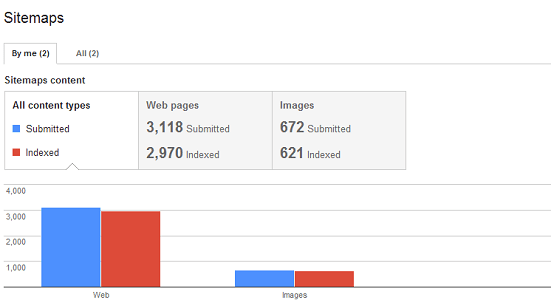
Chances are, Google won’t naturally index every page of your site, so Webmaster Tools lets you go in and add a sitemap that lists them all. If your website has several hundred pages, give it a few days. Then, when you log in, you get to see how many pages are indexed. At first, I used my RSS, but I was surprised to see how little this helped. Google only knew about 11 pages. Eleven! I opted for a WordPress sitemap plug-in, instead, and now 1600+ pages are indexed. Nice!


Changing Sitelinks

Sitelinks are what Google calls all those little sublinks under your domain when someone searches for the domain name. Once your pages are all indexed, you’ll start to see them. Google automatically picks ones that work the best, but the search engine isn’t always right. You can log in to Webmaster Tools, click on a property and add certain links to the ignore list, which strongly encourages the search engine to promote other links, instead. It’s not perfect, but it does afford you some control over your website’s appearance in the SERPs.


Fix Those Broken Links

Four oh dear! No one likes a broken link, but I had quite a few, because my site had been around for so long. I’d transferred blog platforms and domains and permalink structures a couple times. For whatever reason, Google was still thinking that pages from six years ago still existed, when they didn’t. I could have saved some hassle if I started it on my broken links after the indexing completed, but I waded in before. Regardless, you can use Webmaster Tools to look for broken links on your own website–and then fix them! It results in a better experience for your users, and those links can help your PageRank in the long run.